HP 9000/370
Introduced alongside the 9000/360 in 1988,
this is one of the later series 300 machines. It features a 33MHz
Motorola 68030 CPU with 8MB of RAM on the CPU card, upgradable to 48MB
of RAM with a daughterboard that attaches to the CPU card.
The CPU card itself (including any memory daughterboard) occupies only
two of the four DIO-II slots available in the chassis and has no I/O
itself.
A minimal set of I/O is normally provided by a System Interface or Human
Interface Card which occupies the third DIO-II slot. My machine has a
98562-56533 which has:
- 10base2 LAN
- DE9F RS-232
- RCA Speaker
- HP-HIL
- HP-IB
- High-speed HP-IB on a daughterboard with attached cable
Serial Console
If the machine doesn't have a graphics card (or it does, but you don't
want to use it), you can instead use a serial console. In order to do
this, you need to set the REM switch on the HPIB/RS232 switch block on
the System Interface/Human Interface card to ON.
For connecting your PC running a terminal emulator to the RS-232 port
on this card, just use a normal straight-through serial cable. A
null-modem cable is not required and will not work.
Other Notes
-
If the computer has been operated in a dusty environment, a
significant amount of dust can accumulate on the backplane and
the parts of the cards and power supply closest to the fans. When
left for a long time, dust can combine with humidity to result in
rust.
-
Cards may contain glass tantalum capacitors that look kind
of like diodes. Like the normal kind of tantalum capacitors, these
can fail short. But instead of making smoke and fire, they just pop
and leave behind glass fragments.
-
To remove the top cover, undo the two captive screws above the power
supply and remove the power supply cover. The top cover should then
slide backwards and up. If an expander chassis is attached, you'll
need to remove that first and then undo the remaining screw on the
bracket that the expander chassis mounts to.
-
To remove the power supply, undo the two captive screws and take off
the power supply cover. Then undo the single screw in the bottom of
the power supply area and pull firmly on the plastic ring to slide
the PSU out of the back of the case.
-
Capacitor C109 in the PSU (the 330uF 15V aluminium electrolytic next
to the ceramic resistor near the power switch) should probably be
replaced. It was leaking in both of the power supplies in my
HP 9000/370.
My Machine
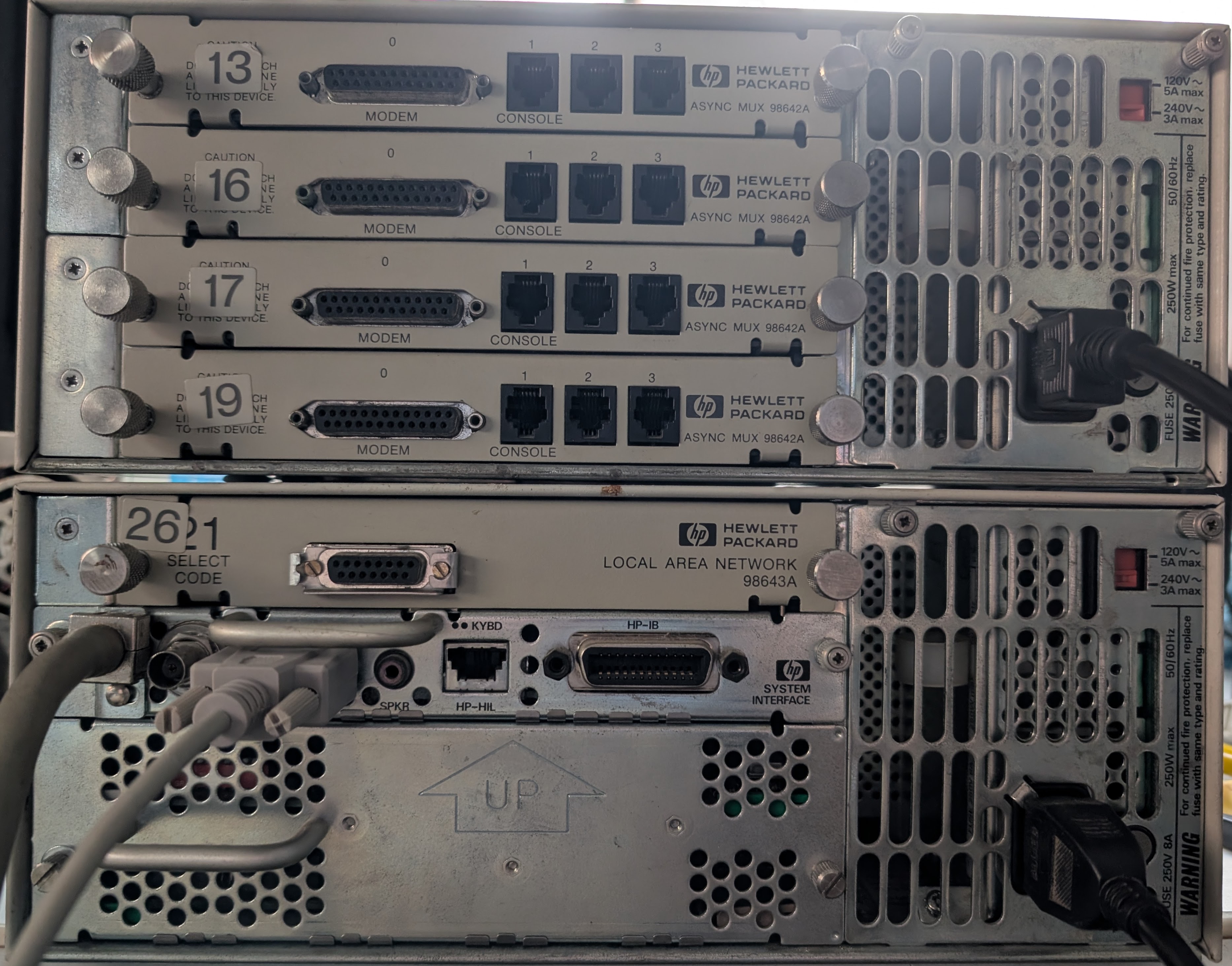
 I have only one of these, which is configured with an expander box
containing four DIO-I slots populated with 98642A ASYNC MUX cards. The
main chassis also has a second NIC, a 98643A, in its single DIO-I slot.
I have only one of these, which is configured with an expander box
containing four DIO-I slots populated with 98642A ASYNC MUX cards. The
main chassis also has a second NIC, a 98643A, in its single DIO-I slot.
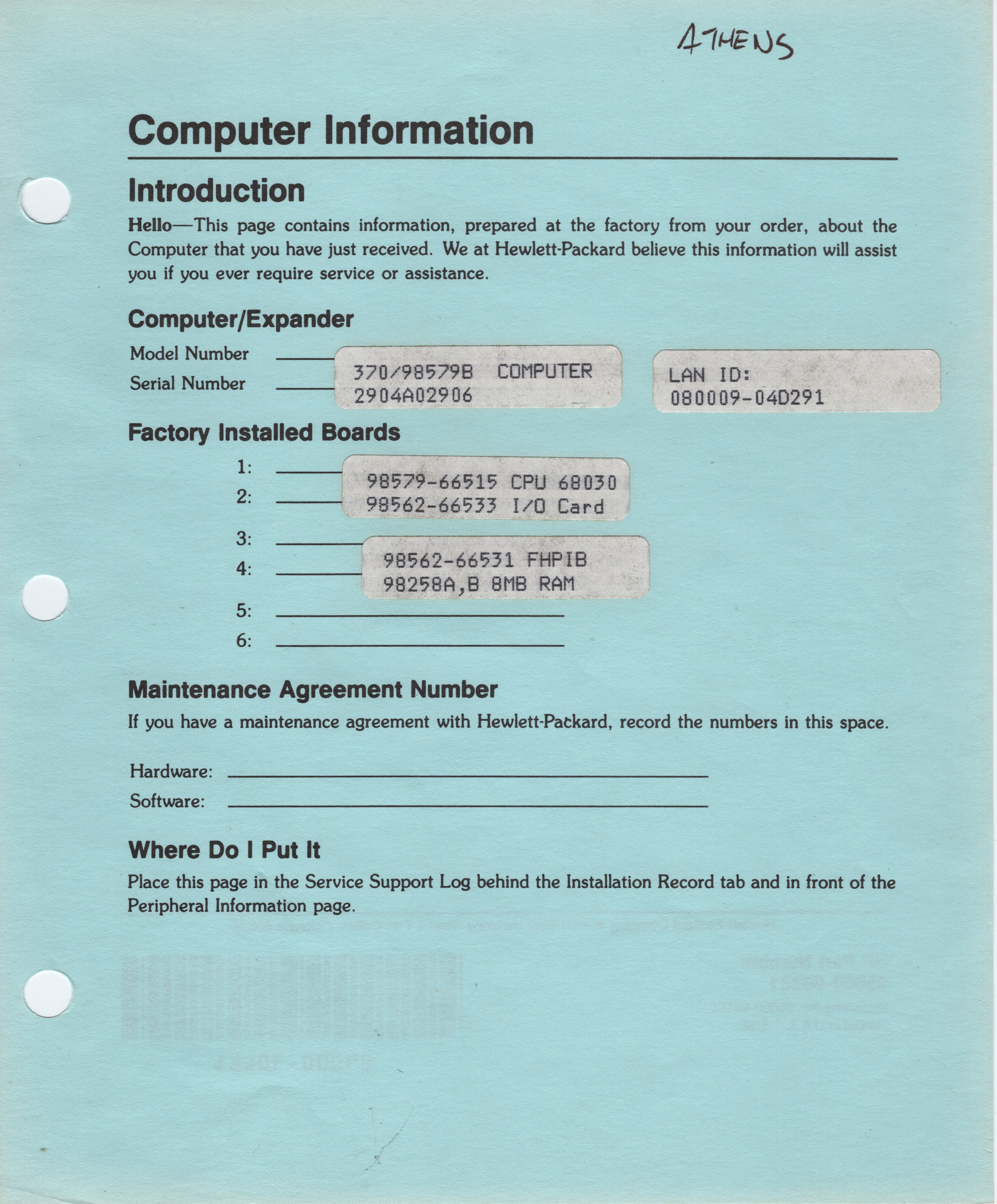
The machine was originally owned by Waikato University and was named
Athens. The Computer Information card
I received with it gives the model as 370/98579B COMPUTER and
lists its factory installed boards as:
- 98579-66515 CPU 68030
- 98562-66533 I/O Card
- 98562-66531 FHPIB
- 98258A,B 8MB RAM
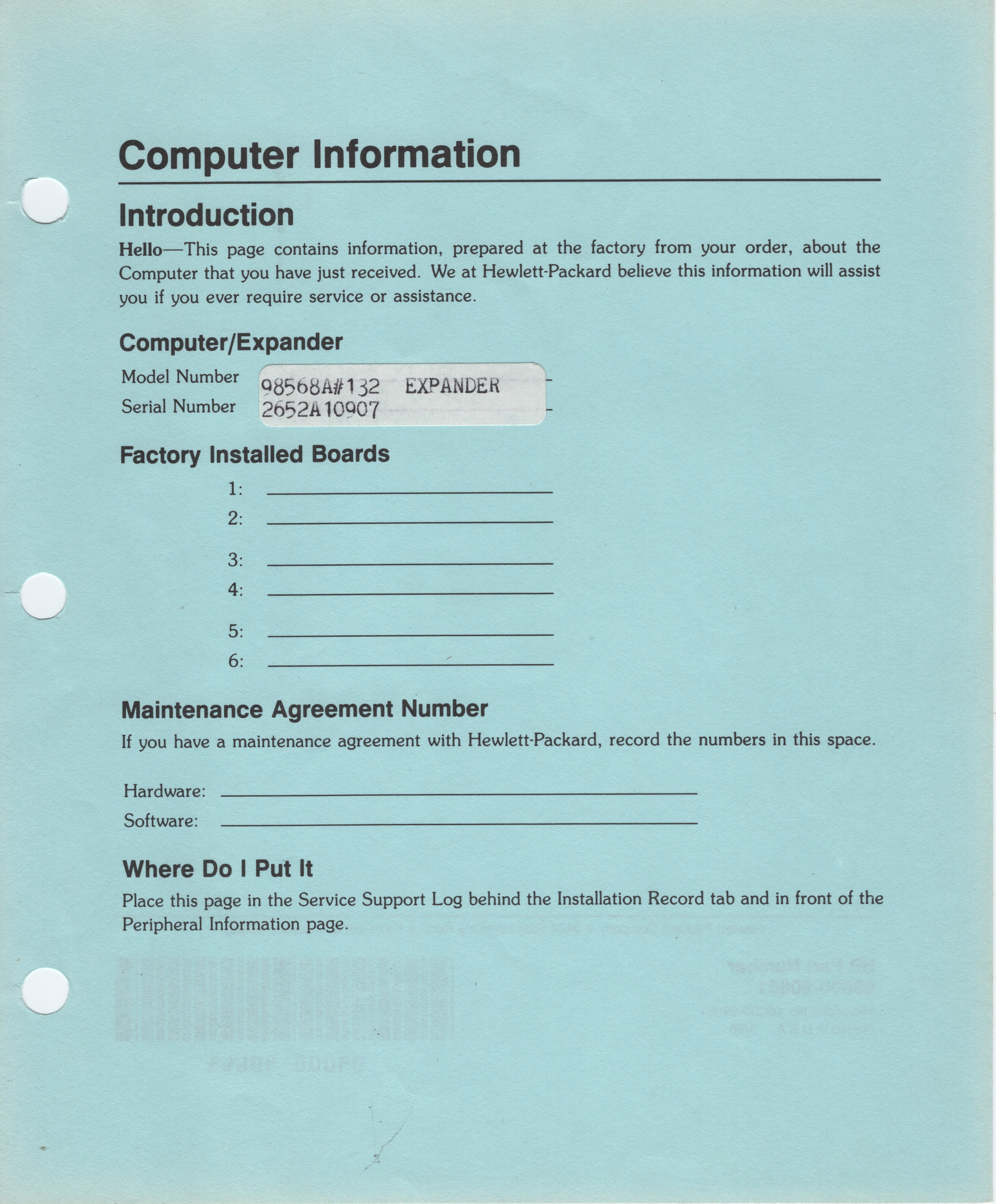
And there is a second Computer Information
Card for the expander, giving its model as 98568A#132 EXPANDER
with no factory installed boards.
The machine appears to be configured with 8MB of RAM currently, which
suggests that the 8MB RAM card may not be working.
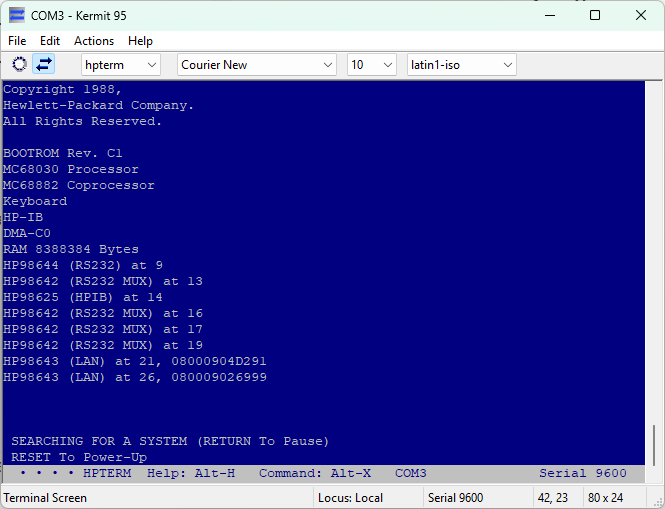
I originally got this machine as part of
a large lot of HP9000 bits,
but due to a lack of HP-IB drives (there is no SCSI interface) I've
never been able to do much with it. In March 2025 I gave it a good
cleaning and replaced some bad capacitors in the PSU getting it back
running again as can be seen in the screenshot of K95 above. My plans
for it from here are to either network boot NetBSD on it, or perhaps
try booting HP-UX from an emulated HP-IB drive.
Documentation
Links